


The 'Khuurug' also known as 'Snuff Bottle' is designed to hold tobacco, typically crafted from precious stones such as agate, jade and coral. Depending on one's wealth and status khuurug's also can be made from materials such as bones, woods, and glass. In early times, people used snuff as a remedy for cold and flu. Overtime, it became an important part of traditional greetings.
When greeting each other by exchanging khuurugs, both persons hold their snuff bottles upright in the palm of their hand to exchange them. The lid is slightly loosened when offering it, and when it is returned it must be handled with same care. During the exchange the bottles should never collide as it is considered a sign of disagreement. More than a greeting 'khuurug' is also used as a tool for peace. In Mongolian tradition, people who've had disagreements with each other exchange khuurug with each other to reconcile and move forward without resentment.
A Brief History
The story of the khuurug begins far from the Mongolian steppe. Tobacco was first introduced to the Qing Dynasty through European traders in the late 16th century. While smoking tobacco was soon frowned upon and even outlawed, the use of powdered tobacco — snuff — was permitted, largely because it was considered a remedy for common ailments like colds and headaches. Since Europeans carried snuff in flat boxes that struggled to keep moisture out in Asian climates, a new vessel was needed: the snuff bottle, sealed and compact, proved far more practical for life on the move.
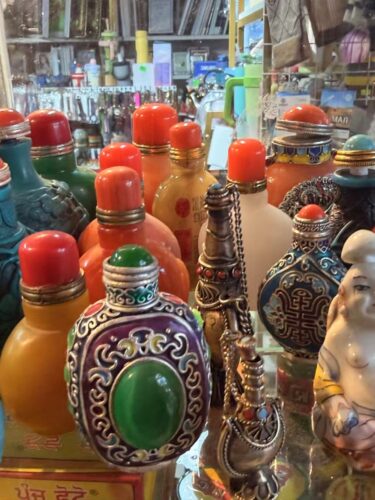
The concept reached Mongolia in the 17th century, initially as an accessory of monks, aristocrats, and high-ranking officials. But Mongolians quickly made it their own. Rather than adopting the Chinese preference for glass or painted clay, Mongolians began crafting their khuurug from precious and semi-precious stones — materials they believed held real healing and protective power. By the mid-18th century, the khuurug had spread beyond the nobility and become a common part of everyday life across all social classes. What began as a borrowed custom had transformed into something distinctly Mongolian.
The Greetings
When greeting each other by exchanging khuurugs, both persons hold their snuff bottles upright in the palm of their hand to exchange them. The lid is slightly loosened when offering it, and when it is returned it must be handled with same care. During the exchange the bottles should never collide as it is considered a sign of disagreement. More than a greeting 'khuurug' is also used as a tool for peace. In Mongolian tradition, people who've had disagreements with each other exchange khuurug with each other to reconcile and move forward without resentment.
Men typically carry their khuurug in a ‘daalin’(a traditional embroidered pouch), either worn in their belt or tucked inside their clothing. The ‘daalin’ is made from materials such as silk and soft leather and is often decorated with detailed pattern and embroiderment. It also traditionally served as a way for a man’s family to judge a daughter-in-law’s sewing skills.”
"Khuurugs are generally classified into four main styles: Manchu, Chinese, Tibetan, and Mongolian. Distinguishing between them or even determining their exact age can be quite challenging.
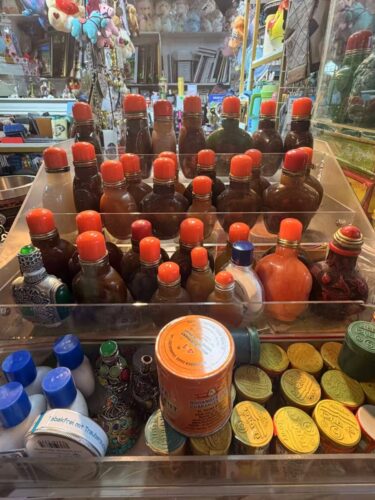
One simple way to tell them apart is by examining the details: sharp, well-defined mouths and threads usually indicate a modern piece, while smooth, worn features suggest an older one. Larger khuurugs can sometimes be identified by their eight threads, which give them a more prominent and refined appearance."
Materials also play a big role in both value and meaning. A genuine jade khuurug, for example, becomes more valuable as it ages. There are said to be seven types of jade and as many as thirty-six types of agate (mana), each with its own unique qualities.
Some materials are believed to carry special properties. Chunchignorov khuurugs are thought to absorb toxins, while sujin is said to help the body retain moisture—hence the saying that one does not feel thirst in the Gobi. Jade khuurugs are often associated with purity, symbolizing a heart as clean as a lotus, emotional balance, and inner peace.
Agate (mana) khuurugs, on the other hand, are commonly linked to family harmony and well-being. Certain types, such as darker agate, are believed to help with joint pain, while yellow agate is said to calm the mind.
The decorative stones also carry meaning. Coral is used to protect against envy and negative energy, while aquamarine or water coral is believed to bring positive energy. Pearls symbolize long life and good health, and turquoise is especially valued for its ability to ease tension, reduce jealousy, and strengthen genuine family bonds. It is often said that turquoise brings abundance and blessings to its owner.
What to consider when buying a ‘khuurug’?
Height of a ‘khuurug’s lid: When measuring the height of the khuurug lid, it should be measured in centimeters from where it begins to where it ends.
Neck and shoulder: The neck is the narrow upper portion of the bottle below the lid. A well propotioned neck should should feel balanced in the hand and transition smoothly into the shoulder. A clean symmetrical shoulder is a sign of skilled craftsmanship and is one of the details worth examining.
Body and base: The body is the main section of the khuurug and the part most people would notice first. This is where the stone truly shines. Look for its polish, color depth etc... The base should sit flat and stable. A khuurug that feels uneven may have been shaped hastily. For collectors the base can also reveal that the bottle is made by hand or produced more commercially.
Size: Khuurugs come in different sizes and the right choice depends on the size of your hands.
A khuurug should sit comfortably in the palm without feeling too large or too small. It is also common for a person to own more than a one. A small everyday bottle kept at home or a more formal piece reserved for special occasions.
The Khuurug Today
Compared to past generations fewer young Mongolians carry a khuurug in daily life. However, the tradition itself is far from gone. Annual exhibitions and competitions celebrate both antique and contemporary khuurug. Craftsmanship training programs and private collectors continue to keep the art alive , and luxury souvenir shops in Ulaanbaatar now offer both antique and modern pieces for visitors who want to bring a piece of Mongolian heritage home with them.
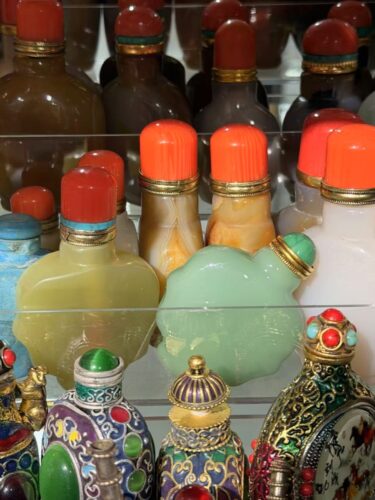
During Lunar New Year, the khuurug exchange remains one of the most important rituals of the celebration. Families bring out their finest bottles, and the simple act of offering and receiving becomes a meaningful connection between generations.


