Capital of Iran for 200 years, a visit to Tehran is a must for those who want to understand this fascinating country.
Tehran is a city of history, revolution, religion and the heart, not only of the country but of the Iranian people. Tehran is a city of contrasts with ancient history hidden behind modern buildings; a bustling, busy, traffic-filled, chaotic settlement surrounded by distant, often snow-capped, majestic mountains.
A city framed in the media as a dangerous religious fanatics playground, a walk around its centre will reveal something completely different.
Highlights
The Den of Espionage (Former US Embassy)
The Den of Espionage (AKA Embassy of the United States, Tehran)
The Den of Espionage may not be everyone’s cup of tea, although if you are a certain age or a fan of the movie Argo it will be right up your street.
The events that occurred on the 4th November 1979 would make the US Embassy in Tehran famous; when militant students in support of the revolutionary leader, Ayatollah Khomeini, stormed and seized the building.
The capture of the embassy would lead to 52 American staff being held hostage for 444 days and the cessation of all diplomatic relations between Tehran and Washington to this day.
Azadi Tower (Freedom Tower)
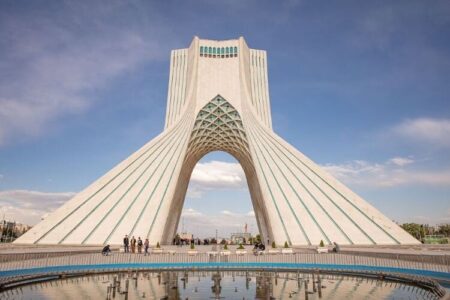
The 50-metre high Azadi Tower is, without doubt, Tehran’s most famed and iconic building. Designed by Iranian student Hossein Amanat in 1966, the tower would be completed in 1971 to mark the 2,500-year celebration of the Persian Empire.
Originally named the Shahyad Tower, the Azadi Tower boasts a basement museum that contains various ancient artefacts such as ancient cuneiform tablets, ceramics, and pottery.
Golestan Palace & Gardens
Dating back to the Qajar dynasty, the Golestan Palace is also known as the rose garden. This ornate, beautifully designed palace was the home of Iran’s kings.
During the Pahlavi era, it wasn’t so much a residence but used for official ceremonies where a little more pomp and splendour were needed. Golestan Palace consists of 17 buildings, including palaces, museums, and halls; its ornately arched ceilings and mirrored floors are a photographer’s delight.
One of the most notable features is the marbled throne which has seen the coronation of many Iranian kings, the last being Reza Shah of the Pahlavi dynasty in 1925.
Isfahan: The World Heritage City
Isfahan, sometimes rendered ‘Esfahan’ has existed as a settlement for thousands of years, however during the Zoroastrian era in Iran, the city began to grow into major regional centre – benefitted by its fertile soil, due to its proximity to the Zayandehrud river.
The city continued to grow, unabated by the turbulent political situation which saw the Seljuq Turks take over the city, allowing it to grow in size and splendour. However, the true golden age of this city occurred during the Safavid dynasty when the city was named the capital of Persia and became famous, not just throughout Iran, but as far as Europe due to its extensive cultural significance and political importance.
Although Isfahan is no longer the political heart of Iran, the culture remains as the city is a major hub for textiles, carpets, traditional food and local handicrafts.
Highlights
Shah Mosque
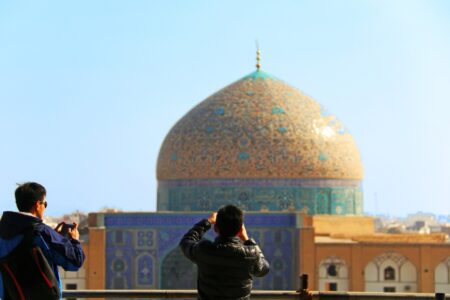
Shah Mosque is an amazing example of traditional Islamic architecture and is famous for having the tallest double-shell dome, reaching a height of 52 metres! Stone tablets inscribed with the words of monarchs past decorate the walls inside the mosque, adding to the sense of divine history which encompasses the complex.
There are also some fantastic examples of Islamic tilework on display, something which you may even get the chance to watch being produced!
Naqsh-e Jahan Square
The World Heritage Site was enshrined by UNESCO in 1979, although the square itself has been standing for over 400 years! This stunning public space isn’t just a rectangular slab of concrete either, immaculately-cut grass and perfectly trimmed hedges adorn the centre of this ancient artefact in the heart of Isfahan.
Jameh Mosque
Another mosque has reached the top 3 list of Isfahan, but for good reason! The Jameh mosque is another World Heritage site and is a stunning example of traditional Islamic architecture in Iran. With the first mosque on the site being built around 771 CE, the modern day iteration of the Jameh mosque is a combination of many different styles from many different periods, all crashing together to create one of the most incredible buildings you’ll find not just in Isfahan, but in all of Iran!
Mashhad: Iran’s Spiritual Capital
The city of Mashhad is the second-largest city in Iran and sits in the north-east of the country near the border with neighbouring Turkmenistan (making it the perfect stopping point for visitors travelling in from Ashgabat). The name Mashhad means ‘Place of Martyrdom’ and takes its name from its most famous and important site, the shrine of Imam Reza – a key pilgrimage site within Iran.
Not only a religious centre, many Iranians know Mashhad as the city of Ferdowsi, a famous Persian poet who enjoys great popularity in modern Iran. The city has been home to many famous writers, poets and other guardians of Persian culture despite being governed by many different cultures and governments during its long history. Today, Mashhad is considered the spiritual capital of Iran, and it’s not difficult to see why.
Highlights
Shrine to Imam Reza
The Holy Shrine of Imam Reza is a lot more than it sounds, considered by many to be the heart of Shia Islam; this large complex is visited by millions every year. The Shrine complex was started in 818 AD and marks the burial site of Ali ibn Musa al-Ridha, a descendant of the Prophet Muhammad (PBUH). This beautiful building covers almost 600,000 m2 incorporating fourteen minarets, seven courtyards, two fountains, four bast halls, and the imposing Goharshad Mosque.
Mashhad Bazaar
Mashhad Bazaar is a real treat, referred to by many Iranians as the world’s heart for saffron it is also seen as a centre for that most Persian of gems, Turquoise. Mashhad Bazaar has an authentic middle eastern feel to it with over 1,100 stalls and 3km of passageways. Visit for a chance to browse everything from saffron worth more than gold, carpets, turquoise, jewellery, prayer beads and more while the smell of middle eastern perfume permeates your thoughts.
Tomb of Nader Shah
Nader Shah was King of Iran during the 17th century; a Turkmen ruler known as the Napoleon of Persia, Sword of Persia, and after his assassination in 1747, the last great Asian Military Conqueror. Although relatively modern, the Mausoleum doubles as a museum and houses some precious artefacts from the time.


 Mongolia Tours
 Turkmenistan Tours
 Caucasus Tours
 Tajikistan Tours
 Kyrgyzstan Tours
 Uzbekistan Tours
 Group Tours
 Independent Tours
 Standard Tours
 Festival Tours
 Budget Tours
 Specialist Tours