
The Beauty of Mongolia Tour
Travel through the vast expanse of rural Mongolia; ancient capitals, ruined temples and vast deserts await us as we journey across this amazing country.


The Beauty of Mongolia Tour
This 10-night adventure starts in Mongolia’s bustling capital Ulaanbaatar and strikes out into the country’s rolling heartland, calling at the once Ancient Capital of Karakorum and the sacred Orkhon Valley before heading south to Mongolia’s famed Gobi Desert. The Gobi Desert is a region synonymous with adventure and excitement.
Once the stomping ground of explorers, fossil hunters, invaders, now welcomes modern travellers searching for the Gobi deserts beautiful extremes.
So travel with us as we glimpse once extinct horses, temples of Kublai Khan’s grand empire, roaring waterfalls, rolling dunes and flame colour cliffs
Highlights
Khongor Sand Dunes are a series of stunning sand dunes set deep within the Gobi Desert, sometimes known as the singing dunes for the sound they make as the wind whistles over their peaks. A great spot for photos as well as a spot of dune climbing.
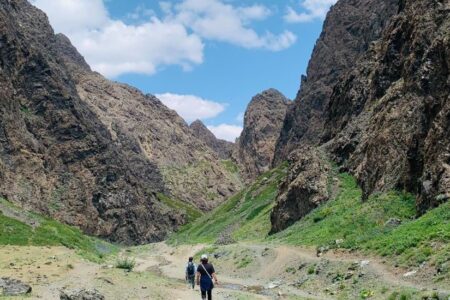
Yol Am Valley is a huge gorge in the Gobi in which eagles circle up from the valley floor riding thermal currents in the air as we explore the valley floor, discovering the frozen river, often remaining icy well into the summer, and the gorgeous views of this natural wonder.
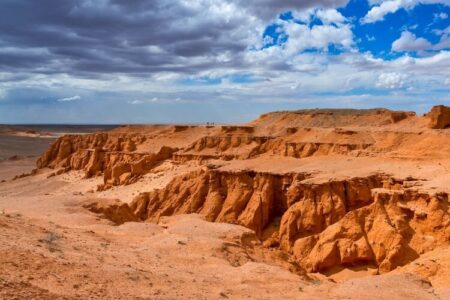
Flaming Cliffs or, Bayanzag, are a series of sandstone cliffs known for their natural beauty, especially at sunset, and the range of fossils discovered there; most notably, the first ever discovery of dinosaur eggs was made at Bayanzag.
Upon landing in Mongolia’s capital, we make our way to our centrally located hotel to recharge before our adventure begins. If you’re feeling energetic, you can take our optional walking tour to get your first taste of this fascinating city before returning for our 4pm hotel briefing.
Here, we’ll give you an overview of the country and culture along with some etiquette tips for visiting the homes of the Shamans, Kazakhs, and Tuvan people we’ll meet along the way. Then join us for a city walk, this time by night. Get a glimpse of Sükhbaatar Square, named after the revolutionary hero Damdinii Sükhbaatar; the statues of Genghis Khan and other Mongolian generals are even more impressive when lit up at night.
This morning the adventure begins as we leave Ulaanbaatar and drive out into Mongolia’s beautiful countryside, making our way to Hustai National Park.
Hustai National Park (Khustain Nuruu) has been a protected area since 1993, a unique landscape containing both mountains and steppe within a relatively small area. The national park is home to the rare Mongolian wild horse known as Perzevalski or Takhi; once extinct in the wild, the Perzevalski Horse is a true conservation success story with captive breed horses released into, and then surviving in the wild.
On the way to the park, we’ll be sure to stop by and visit a local herder family and pay a visit to an area known as the ‘Mini Gobi’, a collection of rolling dunes that look out of place surrounded by green steppe.
Once we arrive at the park, we’ll check into our Gers before grabbing a spot of lunch at the camp restaurant.
Following a hearty meal, we’ll have a little time to view the onsite visitors centre to learn a little more about the region, the horses and various other flora and fauna resident to Hustai National Park.
Mid-afternoon offers us the best time to catch a sighting of the beautiful Takhi horses, so we’ll pile into our trucks drive out into the rolling terrain to spot them come down from mountains for water at the nearby river. As well as the famed Perzevalski horse, it is also possible to see fox, red deer, roe deer, eagles, and other various animals.
Once we’ve finished our Mongolian safari, it back to the camp for dinner and to spend our first night under canvas in our authentic Mongolian Ger.
Accommodation: Hustai National Park
Included Meals: Breakfast, Lunch, Dinner
After breakfast, we’ll continue the adventure with a drive to the ancient capital of Karakorum and Erdenezuu Monastery.
Karakorum was the former capital of the Mongolian Empire. At its height, it was from Karakorum that Genghis Khan’s son, Ogedei Khan, would rule the largest land empire the world has ever known.
During Karakorum’s golden age, much of the city was comprised of tents, and, as the Mongolian Empire went into decline, the city’s decay was rapid. These days, all that remains of this once great settlement is the impressive Erdene Zuu Monastery, as well as a few scattered but not unimpressive archaeological finds.
Once we arrive at Karakorum, our first stop will be Erdene Zuu Monastery; it may be a shadow of its former self; however, it is still impressive. We’ll hopefully catch the resident monks in their afternoon prayer. Following our monastery visit, we will call at the unique archaeological museum to see some recent historical finds.
These days Karakorum has a real melancholic feel to it, and before we head to our Ger camp for the evening, we’ll be sure to cut through its centre so that you can gain a snippet of life in this once grand settlement.
Accommodation: TBC
Included Meals: Breakfast, Lunch, Dinner
Today we depart our Ger camp early, stopping at a nearby shop to stock up on supplies for the journey; we continue south following Mongolia’s ever-changing scenery trailing the famed Orkhon River and its UNESCO listed valley.
The drive to Orkhon takes us through the Khangai mountain range, offering beautiful landscapes comprising of gorges, river valleys and green steppe.
We leave the main track for a small mountainous trail that leads to the Tovkhon Monastery.
Perched atop the sacred Shireet Ulaan mountain, Tovkhon monastery is only reachable on foot: it is from this monastery that the first religious leader of Mongolia Zanabazar composed the Soyombo script. The Soyombo symbol used in that script has become the countries national symbol present on the Mongolian flag and a source of much national pride.
At 2,312 meters above sea level, the monastery offers breathtaking views of the Khangai mountain range and the surrounding area.
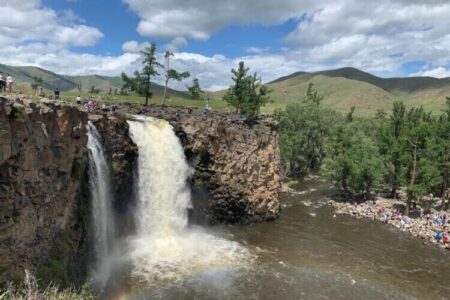
From the monastery, we continue the adventure with one final visit of the day to the Orkhon waterfalls. The Orkhon falls were formed more than 20,000 years ago by a rare combination of earthquakes and volcanic activity; these 16 meter high waterfalls are Mongolia’s largest waterfalls and are simply magical.
Accommodation: TBC
Included Meals: Breakfast, Lunch, Dinner
Today, we transit from the green mountains of Khangai into the Gobi landscape. As we journey, the scenery still impresses as we pass lush green winding river valleys that transition into the Gobi region’s scrub filled desert region.
We pass into Saikhan Ovoo, a small province in Mongolia’s heartland patchworked with green steppe, rugged rock formations and martian landscape type terrain.
Our destination? A place of quiet solitude on the Ongiin Gol river known Ongi Temple. The ruins of two monasteries, Barlim and Khutagt, remain on the north and south shores of the river. We visit this site, commonly collectively known as the Ongii lamasery and its little museum.
Ongi used to be one of Mongolia’s most extensive monasteries and home to over a thousand monks until the destruction in 1937 by the Soviet army. In 2002, some monks returned and began restoration work with a small budget, making up for what they lacked monetarily with inspiring spiritual fervour.
This evening, our Ger camp is located only a stone’s throw from the temple and offers a chance of serene relaxation, further hiking, or exploration.
Accommodation: Secret of Ongii Camp
Included Meals: Breakfast, Lunch, Dinner
After breakfast, we depart our Ger camp and head into the Gobi Desert proper. We journey past the ”Three Beauties”, mountain range derived from the three subranges, the easternmost ‘Zuun Saikhan’, the central ‘Dund Saikhan’ and the westernmost ‘Baruun Saikhan’.
The Gobi Desert is vast, and our foray onto its plains today only gives us a snippet of its actual size, for the Gobi Desert reaches into six Mongolian provinces (aimags) and crosses into China. The Gobi is the sixth-largest desert globally and the second in Asia, a wide-open place of extremes; our first stop is one of these extremes.
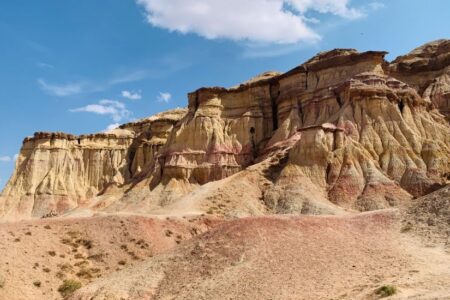
Our main destination for today, Bayanzag – (the Flaming Cliffs), is stunningly beautiful with its flame-coloured sandstone cliffs and canyons. Aside from its obvious wow factor, Bayanzag is also where American palaeontologist Roy Chapman Andrews first discovered the world’s first-ever recorded dinosaur eggs and a mightly haul of various other fossils. A walk along the cliffs here is a walk in the footsteps of the man whom Indiana Jones was modelled on!
Once we have finished our exploration, it’s off to the nearby Ger camp where we can relax, drink, and maybe return to the cliffs to catch the changing colours as sunsets, making a perfect end to an exciting day.
Accommodation: Gobi Oasis
Included Meals: Breakfast, Lunch, Dinner
The adventure continues as we bid farewell to the Flaming Cliffs, board our vehicles and journey onwards through the wilds of the Gobi Desert to the Khongor Sand Dunes (Khongoryn Els) also known as the Singing Sands.
Along the route, we pass some of the typical Gobi terrain, a loose mix of pebbles, gravel and fine sand; however, we will cross a fertile area of steppe where we’ll be sure to visit one of the traditional nomadic families who call this desolate region home.
The Khongor Sand Dunes, as the name suggests, are a dune system found within the Gobi; as only around 3% of the Gobi desert is covered in sand, the sight of these 300 metre high gigantic dunes is something to behold. The shifting sands of Khongoryn Els stretch out for over 180 km, although we arrive in the most impressive area and stay at a Ger camp with views across these giants.
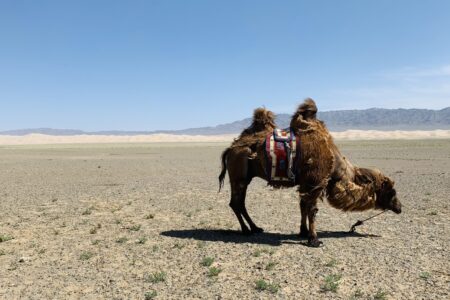
Once we have eaten lunch and waited for the day to cool a little, we’ll continue our adventure and visit one of Khongor’s resident camel herder families. Although most of these herder families are now in this region to supply camels to tourists, we can think of no better way to approach these monstrous sandy giants. After arriving, we will have time enough to climb and explore the dunes; it may take a little longer than you think to climb the amazing giants.
If you are fortunate, you may also experience why they have the name the singing dunes, as when the wind blows across the sand’s surface in the right direction, an eerie sound is emitted, sounding like an aircraft to some and a hidden being to others.
Another day nearing its end, but with much of the Gobi Desert’s natural scenery, the Khongor Dunes come alive at sunset. Maybe view them from the top of the dunes or the comfort of our relaxing Ger camp while enjoying a cold drink after dinner.
Accommodation: Gobi Erdene Ger Camp
Included Meals: Breakfast, Lunch, Dinner
After enjoying a filling breakfast in our Ger camp, it’s back aboard our vehicles as we continue the adventure.
This morning it’s bumpy going as we leave the Khongor area, making our way to today’s destination, the Yol Valley.
As we travel, we will stop for photos along the way as the landscape transitions from a typical sandy desert, hard clay, rock, stone and steppe, summing up how diverse the Gobi Desert really is.
We’ll eventually arrive at the Gurvansaikhan Mountains heading into the Yolyn Am Gorge. Yol Yolyn Am means’ Vulture’s Gorge’. Yolyn Am is a magnificent mountain valley 40 km long and offers those who want to walk an exciting path.
We begin at the valley’s wide entrance, following the small river into the canyons, narrowing cliffs eventually. As the step-sided walls cut the sun from the canyon’s bottom, we will catch a glimpse of the locally famous frozen river. Over the winter months, the river builds up a thick layer of ice, which thaws slowly and, at times, remains long into the summer months. As you follow the winding path, eagles rise to circle in the thermals high above the canyon whilst wild goats can be seen perched on the high valley walls and picas scurry amongst the rocky terrain.
For those who may have used all of their energy climbing the dunes yesterday, there are plenty of horses for rent at the entrance of the canyon.
Once we have finished at the Yol Valley, we will drive to our accommodation for tonight, another well-appointed Ger camp where we will have a chance to chat about our adventures over a drink or two.
Accommodation: Gobi Oasis 1
Included Meals: Breakfast, Lunch, Dinner
After enjoying a filling breakfast in our Ger camp, it’s back aboard our vehicles as we continue the adventure to an area known as Baga Gazriin Chuluu. The trip will take us across typical Gobi scrub, transitioning into the more famed and well-known traditional Mongolian steppe.
As we approach Baga Gazriin Chuluu, it comes as a real surprise a red granite outcrop of rocks rising to 1768 metres above sea level in the middle of the flat, featureless Mongolian steppe.
Baga Gazriin Chuluu is designated a national park home to 20 rare species of plant, ibex, marmot and mountain sheep. The area offers us impressive geology and the chance to explore this and more with some good hikes, which also encompass some of the ancient petroglyphs and burial mounds found in the area.
Should time permit on our journey, we will also have time to interact with a few more local nomadic herders who will also be passing through the region (just on a longer journey). Time permitting, we’ll stop for the ubiquitous cup of milky tea before continuing on our own adventure.
Once at the ger camp, for those who wish, there may be the opportunity for some optional horse riding, a great location to experience a ride out on a true Mongolian steed.
Accommodation: Local Ger Camp
Included Meals: Breakfast, Lunch, Dinner
After a leisurely start to the day, we say a fond farewell to the Gobi Desert and continue our long journey back to Mongolia’s capital, Ulaanbaatar.
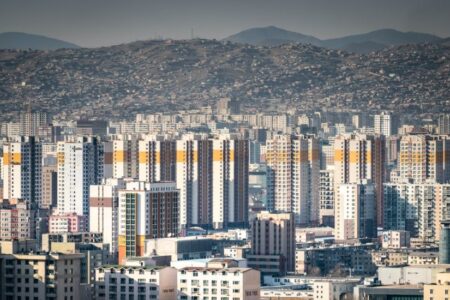
However, our tour isn’t over as we’ll arrive back in the city and visit one of the more modern, upmarket parts of the city. This southern edge of Ulaanbaatar, nestled in a valley of the Bogd Khan mountain, is called Zaisan – one of the more recent additions to the city.
We’ll visit a modern shopping mall, complete with monuments to old Soviet Tanks, and also climb the hill at the centre of the district which is topped with an incredible old Soviet Monument. From here, we’ll get an incredible view over the entire city – the perfect way to bring our adventure to a close.
Finally, we’ll head to dinner, after first passing by an oddly out-of-place giant golden statue of Buddha built by the South Koreans.
We’ll spend our farewell dinner reminiscing about our adventures across Mongolia, and wrapping up our incredible expedition.
Accommodation: Hotel 9, Ulaanbaatar
Included Meals: Breakfast, Lunch, Dinner
Today, it’s time to bid goodbye to Mongolia. Although the tour is over, we hope you’ll be flying home with a head full of memories and stories to share with your friends and family!
Included Meals: Breakfast
END OF TOUR
Gers, Gers, Gers
On the first night of our tour, we’ll stay in the centrally-located, well-appointed Hotel 9 near Sukhbaatar Square in the capital of Mongolia, Ulaanbaatar. For the rest of the tour, however, we’ll spend our nights in some of the Gobi Desert’s locally-operated Ger camps.
A Ger is a traditional Mongolian dwelling, often mistaken for the similar-in-design Kazakh Yurt. These camps offer fantastic views out over the surrounding environment and often come with modern amenities to make your stay more enjoyable. On this tour, we’ll stay in two different camps – the Gobi Oasis Ger Camp and the Gobi Erdene Ger Camp.
Accommodation on the Beyond the Steppe Tour
 Hotel 9 - Ulaanbaatar
The Hotel 9 is located only a stone’s throw from the heart of the city, Sukhbaatar Square. A modern, well-appointed hotel with clean, comfortable rooms and easy access to the rest of the city. We’ll stay here on the first night of the tour, allowing us to get a well-earned rest before heading out to the wilderness. We’ll also stay at the Hotel 9 on the final night of the trip as we return triumphantly to Ulaanbaatar.
On top of all it’s benefits, we’ll be able to enjoy a lovely buffet breakfast (with a really good coffee machine!). Despite its modest 3-star rating, it gives off a 4-star feel.
Tourist Ger Camp The best way to picture a tourist ger camp is to replace a hotel room with a traditional Mongolian Ger (tented dwelling); these are dotted around a set area and offer comfortable beds and shelter. For many tourists, the Ger Camp is a real home away from home, offering beautiful Gers with gorgeous views across the surrounding environment.

 Mongolia Tours
 Turkmenistan Tours
 Caucasus Tours
 Tajikistan Tours
 Kyrgyzstan Tours
 Uzbekistan Tours
 Group Tours
 Independent Tours
 Standard Tours
 Festival Tours
 Budget Tours
 Specialist Tours